


Saratoga (408) 741-9982 Redwood City (650) 227-9693
Translate icon
Book Now

What Is Chin Augmentation?

Chin augmentation restores balance to the face by increasing the size or projection of the chin. A silicone implant is placed over the bone to increase projection and contour. Our chin augmentation in San Jose is often done in conjunction with a facelift or nose surgery to achieve optimal facial balance and harmony.

Who Is a Candidate for Chin Augmentation?

If your chin is small and does not project enough to define your jawline, you may be a candidate for chin augmentation surgery. A chin augmentation or sliding genioplasty creates more balance and harmony to the face using an implant customized to your chin and face.

Cheng Plastic Surgery was established by a brother-sister team of double board-certified facial plastic surgeons, both of whom have extensive experience with chin augmentation surgeries.

Banner media
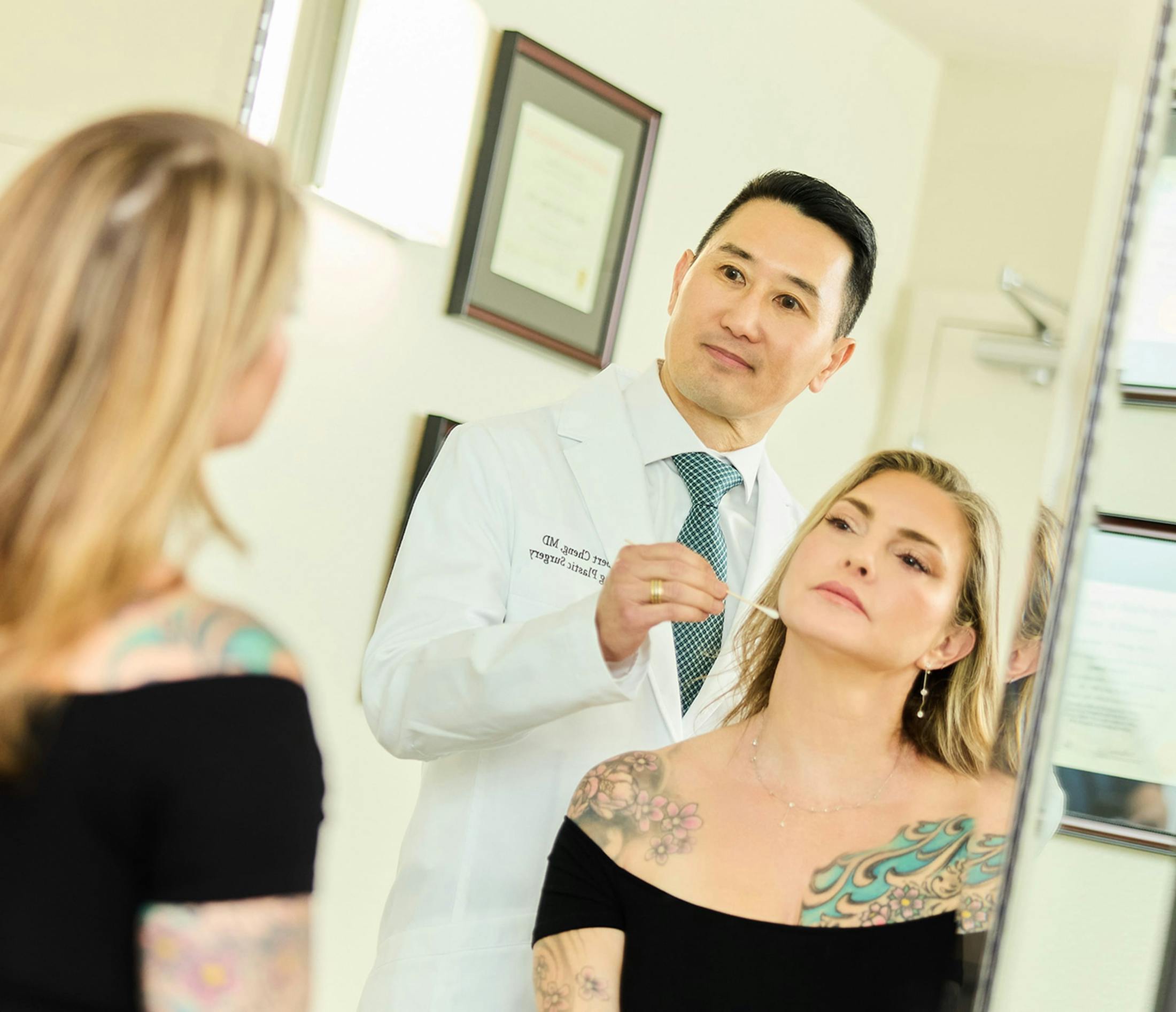
doctor inspecting patient's face

Your Chin Augmentation Procedure

Cheng Plastic Surgery is a state-of-the-art plastic surgery center with two operating rooms and a full staff of certified medical professionals. You can be assured that your chin enhancement in San Jose is in skilled, experienced hands for the best outcome possible.

  • Local anesthesia is the most common method to place a chin implant. When bone repositioning is required, general anesthesia is recommended.
  • In the case of a chin implant, the incisions are usually under the chin or inside the lower lip. In both cases, scars are in discrete locations. The surgery takes less than a half hour after the anesthesia has taken effect.
  • A pocket is created in the chin, and the implant is placed over the jawbone. The incisions are then sutured closed.
  • The chin implant is customized to your facial shape and proportions. This handcrafting of the implant is done by Dr. Cheng in the operating room. Most implants are made of silicone, which has an excellent safety record.

Chin Augmentation Before & After

Recovering From Chin Augmentation

  • We will tape your chin after surgery and apply a dressing around your head. The dressing reduces swelling and protects the incisions from the environment. It will be removed in a few days. We will provide instructions that cover every detail of your recovery, including bathing, foods, and how to limit bruising and swelling.
  • Most patients take 7-10 days off from work to heal from chin enhancement. You must avoid any strenuous exercise or sports for at least a month.
  • If your incision was inside the mouth, the sutures will dissolve on their own. If the incision was made beneath the chin, the sutures may not dissolve and will be removed in a week during a follow-up examination.
  • Some bruising, swelling, tightness, numbness, and discomfort are to be expected after the surgery. We will provide oral and topical medication to speed the healing of the bruising, and you can take pain medication as needed.
  • Cold packs and keeping your head elevated while sleeping will also help to reduce swelling.

Chin Augmentation FAQs

How do surgical chin implants work?

A surgeon makes a small incision either inside the mouth (along the lower lip line) or externally under the chin. A biocompatible implant, typically made of solid silicone or porous polyethylene, is placed directly over the jawbone and secured with sutures or small screws to permanently enhance the chin's projection and profile—a procedure frequently paired with a neck lift for complete lower facial harmony.

Where are the incisions placed for a chin implant, and will they leave a visible scar?

Incisions are placed either inside the mouth (intraoral) or underneath the chin (submental). An intraoral incision leaves absolutely no visible scarring. A submental incision leaves a very small, well-hidden scar under the jawline that typically fades significantly over time and is difficult to see from a normal standing perspective, often blending seamlessly when performed alongside a mini facelift.

Are chin implants permanent?

Yes, surgical chin implants are designed to be permanent and do not wear out. However, they can be surgically removed, adjusted, or replaced if a patient experiences complications, shifting, or chooses to combine structural enhancement with full lower-face rejuvenation, such as a surgical facelift, later in life.

What are the potential risks and complications of surgical chin augmentation?

Risks include infection, bleeding, implant shifting or asymmetry, poor wound healing, and allergic reaction to the implant material. There is also a small risk of temporary or permanent nerve damage, which can cause numbness in the lower lip or chin area due to the proximity of the mental nerve. Discussing your goals during a facelift or chin augmentation evaluation ensures your surgical plan minimizes these risks.

Can I achieve chin augmentation without surgery?

Yes. Non-surgical chin augmentation uses robust dermal fillers (such as Juvéderm Voluma or Restylane Defyne) injected directly above the bone to add projection, structure, and definition. This is a quick, zero-downtime option lasting 12 to 24 months, though patients seeking permanent lower-face contouring often explore surgical alternatives such as a chin implant, a targeted neck lift, or a mini facelift.

Can chin augmentation be combined with rhinoplasty for overall facial balance?

Yes, pairing chin augmentation with rhinoplasty is one of the most effective ways to balance facial proportions. A receding chin can make a nose appear larger than it actually is; aligning the projection of the chin alongside cosmetic nose reshaping creates a cohesive profile from the forehead down to the neck.

What is the difference between a chin implant and neck liposuction for improving the jawline?

While a chin implant adds skeletal projection to strengthen a weak chin, neck liposuction removes excess submental fat beneath the jaw and under the chin. For patients dealing with both bone deficiency and localized fullness, combining an implant with neck contouring or a neck lift delivers the crispest cervical angle.

How long is recovery after chin augmentation, and when will I see final results?

Most patients return to non-strenuous routines within 7 to 10 days, though mild swelling and tightness can take several weeks to resolve completely. Patients interested in addressing upper and mid-face aging simultaneously often combine recovery with complementary procedures like blepharoplasty (eyelid surgery) or a subtle brow lift to refresh the entire face under a single recovery timeline.

art
Contact us media
Accessibility: If you are vision-impaired or have some other impairment covered by the Americans with Disabilities Act or a similar law, and you wish to discuss potential accommodations related to using this website, please contact our Accessibility Manager at (408) 741-9982.
Translate icon